Showing posts with label Yucatan. Show all posts

Sunday, July 28, 2019

SUMMER 2019, PART 1-I: MAYAPÁN & KANKIRIXCHE

Our adventures in Yucatan, Mexico ended with a visit to one more archeological site and one more cenote: Mayapan and Cenote Kankirixche.

Mayapán is known for being the "Bandera de los Mayas" (Flag of the Maya) and it is considered the last main Maya Capital. This city hosted "La Liga de Mayapán" (The league of Mayapán) where the powerful political leaders of both Uxmal area and Chichén-Itza area came together for peace talks. And every year, the league would come together to celebrate their alliance in Mayapán.

Mayapán's main attraction is a pyramid similar to El Castillo in Chichén-Itzá, except much smaller. It is also known as "El Castillo." And unlike the one in Chichén-Itzá, we were allowed to climb it.

Mayapán covers 42 km2, which is about 10, 378 acres. In this area, one can find about 4,000 different structures. It has civic, administrative, and religious buildings.

Many residences, including government official houses, which have long corridors, altars, and several rooms and columns.
There are also buildings with small altars for "lesser deities."

One can also find observatories, and sanctuaries.
After we visited Mayapán, it was time to take a swim in a cenote. There are so many cenotes around Mayapán, some who have been turned into tourist attractions, others who are just happened to be visited by people who dare to find it.

We are such people and it took us about 30 minutes, getting lost, and driving in a very narrow mud road to find what was promised by a local Maya as breathtaking cenote called Kankirixche, known to mostly local people. AND IT WAS!

 At first sight you wouldn't know there is a cenote here. See, the tree, well, it marks the spot where the water whole is located.
 Once you reach the tree you can see a huge whole in the ground.


From the inside it looks like this:

The water is cool, very blue and very clear. The deeper you go, the darker the water gets. The image above was taking from the deeper side of the cenote. To my immediate right it gets deeper and if one dares, one can swim down and go under a cave. BUT what would anyone want to swim deeper and go under a dark underwater cave?

Here's a video, which I took while swimming so once in a while the camera is turned the wrong way:


Next: OAXACA during its biggest festival: LA GUELAGUETZA!

Saturday, July 27, 2019

SUMMER 2019, PART 1-H: IZAMAL

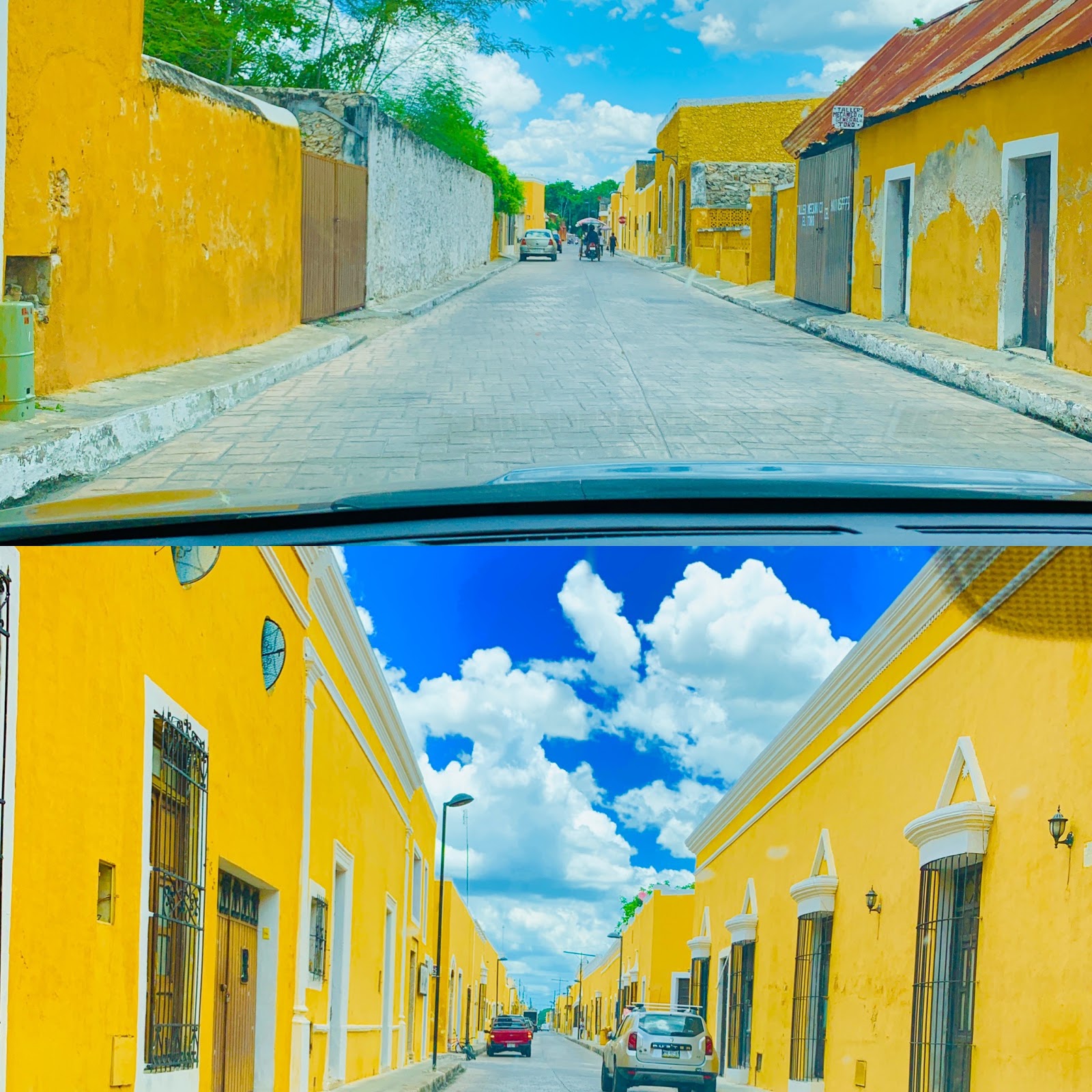
Thirty minutes east of Merida Izamal, the "yellow city" is found. It has three great attractions:

1. All the houses in Izamal are painted yellow, hence the "yellow city."
The image above is a combination of two shots take from my car.

2. Izamá has a monastery with the 2nd larges patio (second only to the Vatican). More about it later.

It's a eyesore to see such building. It is just immense. The monastery is now out of commission, it simply houses a chapel, a museum, and a small arts & crafts store.

3. The biggest pyramid (by square footage) is found is this town and it is known as Kinich Kak Moo, dedicated to the one of the most important deities of the area: Kinich Kakmo, which means the fire macaw with the sun face."

This pyramid is hidden underground and also seen overground. It is so vast that it is bigger than any other pyramid in Mexico (when it comes to square footage).

The image above is the beginning of the pyramid steps (face 1). It is a long way up.

Once you reach the "top" you find a large field, which you still need to cross in order to reach the beginning of the top of the pyramid.

Above, you can see Miguel climbing the pyramid. I am climbing the pyramid too but I am taking my time because I'm me.

Despite the fact that the pyramid was destroyed to build other houses and churches, this pyramid can be seen from all around the town.

Here's a video taken from the top of the pyramid:


Now for my #selfdecolonizing moment:

The reason why the monastery has a very long patio is because when the colonizers (yes, that is what they are) arrived in Izamal they decided to destroy the pyramids, which were temples to the Maya Gods. So, as part of their colonization, they build Christian churches on top of the pyramids.

In the case of monastery, they have to cover the entire square footage of the pyramid and use part of the pyramid to build the church as you will see in the image below.

The front of the monastery looks pretty, and the back shows the stones from the pyramid that were repurpose to build such monastery. If you look at the combined image of the monastery (posted earlier), you will see that the floor and the steps leading to the main entrance are all made of stone, stone that came from the pyramids. So, seeing this makes me angry and sad. It happened and now we just have to accept it.... but I can still be angry about it.

NEXT: MAYAPAN & KANKIRIXCHE!

Friday, July 26, 2019

SUMMER 2019, PART 1-G: DZIBILCHALTUN

Once we were back from Playa del Carmen, we had just three more days to enjoy Merida and Yucatan in general.

About 30 minutes from our rental house, which is the best house we have ever rented, there is a small, but very important archeological site, DZIBILCHALTUN. The name means "place where writing is found on flat rocks."

The site is beautiful, very green, with lots of trees and it even has its own cenote or rather ojo de agua (water whole).

The main attraction seems to be cenote, for everyone can go swimming in it, and we did. To me, however, the main attraction is the "House of the Seven Dolls," name because when excavated, they found seven small female figurines.

But the whole site is just breathtaking. Looking around you hear the birds sing (lots of them by the way), you see iguanas, you see strange trees with strange flowers, and of course MOSQUITOS.

And because humidity is at 1000%, you look like this in front of one of the most beautiful "ojos de agua" I've seen.

From afar, the water looks so crystal clear blue, and once in it, it turns green... what sort of magic is at work here?
 Fresh refreshing water that calms the day heat.

The most spectacular event about this site happens in March and December, where the sun comes up and shines through the house.... I mean, the house was built in a way that is perfectly aligned with the sunrise.

The Maya people did not do things by chance. Everything was calculated!

NEXT: IZAMAL!

Wednesday, July 24, 2019

SUMMER 2019, PART 1-D: UXMAL

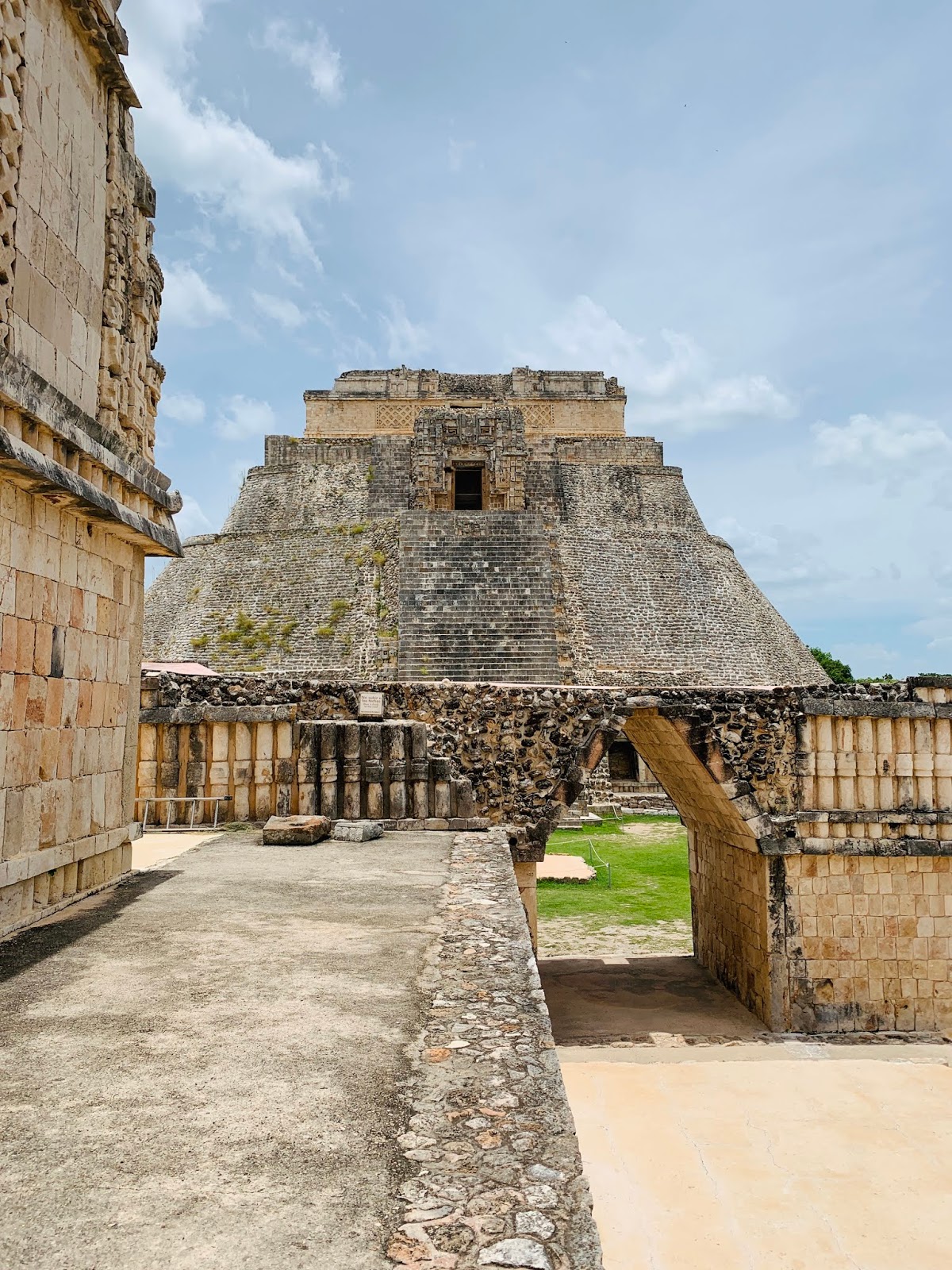
Wikipedia says that Uxmal is an ancient Maya city of the classical period. It is located in the state of Yucatán about 85 km (52 miles) from the city of Merida. It is considered a very important archeological site and to many people, like me, far more impressive than Chichén-Itzá.

Unlike Chichén-Itzá, Uxmal is deep in the jungle, which gives it a very magical feel. It is said that this is a magical city that was build over night by the king who used magic to make it happened.

By design, Uxmal is far more impressive to me, and obviously to the world for it has been declared a UNESCO World Heritage Site.
The name Uxmal means "three times built" and also "What is to come."

The May were very advance people, I mean, they had already integrated the used of the computer cursor in their architecture.
Uxmal's pyramids are magnificent, and unlike in Chichén-Itzá, one is allowed to climb such buildings, if you are actually able to do it.
For me, one of the most admirable things about this city is how some of the buildings have round edges while others have sharp edges, but no matter what, the architecture, the lines, and the angles are perfect all around.
I mean, just look at the precision of this pyramid steps. A straight line from top to bottom.
While the pyramid is round, the steps are straight with very sharp angles. 


And last but not least, the humidity and exhaustion in our bodies... but oh, what a joy to be here!


SUMMER 2019, PART 1-C: PROGRESO

The third day of activities took place in the city o f Progreso, Yucatán. Because this city is so close to Merida, there were several highlight stops along the way to Progreso.

First stop in Progreso was EL CORCHITO, a natural reserved with lots of "Ojos de Agua" (literately, water eyes) better translated to water holes.

This place is so relaxing and so damn green that it just invites you to stay all day long.

Miguel and swam in this "ojo de agua" for about two hours before we decided to look around the area.

The only part of the area that had some sun was this water hole, everywhere else we we covered by trees.
After a few hours in EL CORCHITO, we decided it was time to keep on moving.
And moving we did.

Next stop were the beautiful pink beaches of progresso... which are not actually beaches but water damns that produce natural salt. And the algae, which has red roots, turns the water pink.
 Yet, coming to this water damns or natural fabric salt lakes is very breathtaking.
Here we only stay for about 30 minutes. It was just too damn hot and humid and no shade to keep our bodies cool.
Next stop and beyond the beaches of Progreso, the pink flamingos, which live in harmony and are protected by the local and federal government.
The image above has no filters. That is how this are looks like. PINK all around... and the flamingos are cool.
After taking the obligatory pictures with the flamingos, and trying to understand why the closer you get the less pink the water looks, we headed off to Progreso Beach to have a nice meal and relax for the rest of the day.
Three in Mérida, Yucatán and I'm already sunburn. My husband, who is darker than me, suntanned like a Aztec Warrior while I sunburned like a red lobster. And yes, it is incredibly hot and incredibly humid... thank the gods for the cenotes and the beaches!

NEXT: UXMAL!

SUMMER 2019, PART 1-A: MERIDA, YUCATAN, MEXICO


Our summer 2019 vacation was met with anticipation. While in 2018 we were excited to spend a month in London, England, this time we decided it was time to spend time in our own native country and to top it off, we decided that one month was not enough so we added two extra weeks to make our stay a total of 6 weeks. 

The idea was that if we were willing to spent a month in Europe, visiting castles and enjoying architecture, why not enjoy the same in our own country? And so, the trip began with two weeks in Merida, Yucatán, México. And while we anticipated it that it was going to be a hot summer, we were not really ready for a 100% humidity every single day we were in Yucatán. So, if in some pictures we look like we are wearing two colored shirts, that is because they are soaked in sweat. 

Merida is a beautiful, colorful very colonial and very Indigenous city. The native people are all 100% Maya people and they speak the Maya language. In fact, most Mayas today are bilingual, speaking Maya and Spanish. Many are trilingual, speaking Maya, Spanish, and English. Some are polyglots, speaking up to five languages, including French, German, Dutch, and Portuguese. 

Merida (as well as the entire state of Yucatán) is very proud of its Indigenous roots and traditions, for this reason, the city hosts free cultural events everyday of the week. Tourists, like ourselves, can enjoy different events depending on the day of the week. We arrive on a Wednesday and on that evening we saw a dramatic presentation about the founding of the city.

The dramatic presentation takes place on the street, in front of one of the oldest and most beautiful houses in the city's center, La Casa de Montejo. The dialogue is between a Maya Chief and the son of aSpanish conquistador named Francisco de Montejo, the lieutenant. Hi son, also named Francisco de Montejo (because Spaniards are very creative with family names) was known as "El Mozo" (the son) and he's the one that conquered the Maya city known as T'ho. In the dramatization, the Maya Chief and The Mozo have an exchange of dialogue that relates how T'ho has been destroyed and taking over by Montejo and then given the name of MERIDA, to honor the original Merida in Extremadura, Spain. For me, the best part of the dialogue was the following (and I'm paraphrasing):

                       Maya Chief: "You have destroyed our houses, our temples, T'ho, our city."

                       El Mozo: "The rocks from your temples have built our houses and churches. Our City."

                       Maya Chief: "Our city, T'ho, is no more."

                       El Mozo: "Your city is the foundation of our ours."

One thing I loved about every single cultural presentation was the fact that regardless of what it was, there was always a consciousness to let the audience know that the Merida and the entire state had been colonized by the Spaniards, and that despite such colonization, the Maya still thrives. 

One of my favorite presentation was the Vaqueria Yucateca, which is basically a presentation of Maya/Yucatán customs from all over the state. This presentation, however, is done through traditional  folklore dancing. 

An exciting presentation is watching Maya people play soccer, also known as Pelota Maya or in original name: Poktapok. The game is like today's game except that instead of using their feet to hit the ball, they have to use their hips. Not easy to do and not easy to score a goal either. 


A very colorful presentation is what is called "mapping," which is basically projecting images on stone buildings. In this case, the mapping had to do with Merida's main church, La Catedral de San Idelfonso, (Saint Idelfonso Cathedral). The mapping tells you the story of two buildings: A pyramid, which I forget its name and the cathedral... and how the cathedral was built on top of the pyramid (as the colonizers did to EVERYTHING in  Mexico and Latin America). The image below shows where the pyramid used to be, of course, now reflected onto the cathedral's main entrance wall. At the end, the storyteller says, "two gods, two cultures fused into one." And very subtle it reminds people of the colonization and how the Maya people continue to thrive with their own traditions.

Moral of the story: The Maya might have been conquered but they still alive, thriving, and spreading their traditions to the world.