Thursday, July 25, 2019

SUMMER 2019, PART 1-E: DOMINGOS DE VAQUERIAS

On our first Sunday in Mérida we found out the main city's square turns into an arts and crafts fair so we decided to stay in town for it. We also found out that twice during the day the Ballet Folklórico of Mérida presents its SUNDAYS OF VAQUERÍAS series.

According to the host, Merida has three different ballet folklórico levels. Juvenil (teenagers), Titular (Adults), and Professional (State Ballet). The first two are the ones that do the free presentations every day in Merida while the professional ballet is the one that represents the state nationally and internationally. The photos you see here are from the "Titular Ballet" (Adults).

To be part of the ballet companies, you must have some basic knowledge of folklore dancing both regional and national and also meet certain requirements. For example, to be part of the Titular Ballet (Adults), you have to

Be single
Be skinny
Be at least 5.3 (female)
Be at least 5.7 (male)
Be between 18 and 23 yrs old.
Have a "good complexion" (meaning attractive)
Be in good health
Be able to practice M-F from 8pm to 10 pm.
NO EXCEPTIONS. Y

Or you can start from the very bottom: be part of the teen ballet and move up.

The dances presented by the Ballet Folklorico de Merida tell the stories of the people of Yucatán and their traditions. For example, this particular presentation we saw was about a Maya wedding and the dances that take place as part of the ceremony.

According to the host, a Maya wedding can only be performed by a Maya Priest. And the ceremony starts and ends with different dances. The presentation of the parents, then groom, then the bride, then the witnesses... each of those are dances, and then, the dances after the wedding. Once all the ceremonial dances are done, the big "party dance" takes place.

There are two very popular dances within the repertoire: 1: Las mujeres que se pintan (the women who put on makeup) and 2: EL Torito (The bull). The first dance celebrates women's beauty with or without makeup while the second dance is about courting. The interesting thing about the bull dance is that the bull is the woman and by the end she gets to accept or reject the male's invitation to become a couple. It is a very physical dance and one that also is funny.

The image above is from the dance Las mujeres que se pintan.
The image above is from the dance El torito. 

My favorite dance, however, is the one where both women and men place a trade with glasses full of water on their heads and at some point they spin so fast that the water starts to come out of the glasses creating rain. This dance is called "El Ferrocarril" (The Train). Unfortunately, I was so into watching the dance that I did not take any pictures. Fortunately, I did take video of the dance:


Wednesday, July 24, 2019

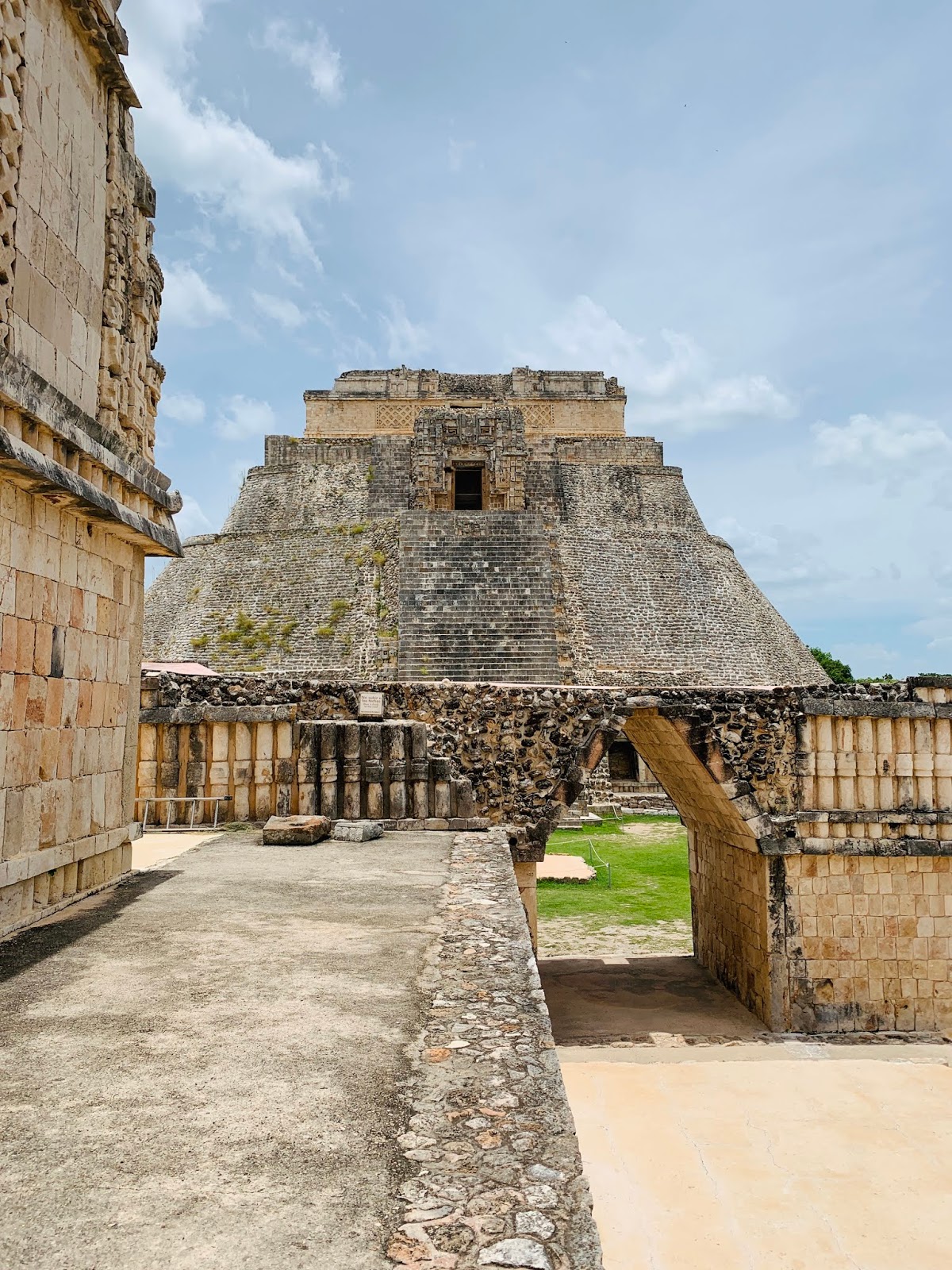
SUMMER 2019, PART 1-D: UXMAL

Wikipedia says that Uxmal is an ancient Maya city of the classical period. It is located in the state of Yucatán about 85 km (52 miles) from the city of Merida. It is considered a very important archeological site and to many people, like me, far more impressive than Chichén-Itzá.

Unlike Chichén-Itzá, Uxmal is deep in the jungle, which gives it a very magical feel. It is said that this is a magical city that was build over night by the king who used magic to make it happened.

By design, Uxmal is far more impressive to me, and obviously to the world for it has been declared a UNESCO World Heritage Site.
The name Uxmal means "three times built" and also "What is to come."

The May were very advance people, I mean, they had already integrated the used of the computer cursor in their architecture.
Uxmal's pyramids are magnificent, and unlike in Chichén-Itzá, one is allowed to climb such buildings, if you are actually able to do it.
For me, one of the most admirable things about this city is how some of the buildings have round edges while others have sharp edges, but no matter what, the architecture, the lines, and the angles are perfect all around.
I mean, just look at the precision of this pyramid steps. A straight line from top to bottom.
While the pyramid is round, the steps are straight with very sharp angles. 


And last but not least, the humidity and exhaustion in our bodies... but oh, what a joy to be here!


SUMMER 2019, PART 1-C: PROGRESO

The third day of activities took place in the city o f Progreso, Yucatán. Because this city is so close to Merida, there were several highlight stops along the way to Progreso.

First stop in Progreso was EL CORCHITO, a natural reserved with lots of "Ojos de Agua" (literately, water eyes) better translated to water holes.

This place is so relaxing and so damn green that it just invites you to stay all day long.

Miguel and swam in this "ojo de agua" for about two hours before we decided to look around the area.

The only part of the area that had some sun was this water hole, everywhere else we we covered by trees.
After a few hours in EL CORCHITO, we decided it was time to keep on moving.
And moving we did.

Next stop were the beautiful pink beaches of progresso... which are not actually beaches but water damns that produce natural salt. And the algae, which has red roots, turns the water pink.
 Yet, coming to this water damns or natural fabric salt lakes is very breathtaking.
Here we only stay for about 30 minutes. It was just too damn hot and humid and no shade to keep our bodies cool.
Next stop and beyond the beaches of Progreso, the pink flamingos, which live in harmony and are protected by the local and federal government.
The image above has no filters. That is how this are looks like. PINK all around... and the flamingos are cool.
After taking the obligatory pictures with the flamingos, and trying to understand why the closer you get the less pink the water looks, we headed off to Progreso Beach to have a nice meal and relax for the rest of the day.
Three in Mérida, Yucatán and I'm already sunburn. My husband, who is darker than me, suntanned like a Aztec Warrior while I sunburned like a red lobster. And yes, it is incredibly hot and incredibly humid... thank the gods for the cenotes and the beaches!

NEXT: UXMAL!

SUMMER 2019, PART 1-B: CHICHÉN-ITZÁ

Because while staying in Merida the idea was to visit different places in Yucatán and perhaps Quintana Roo, I rented a car. With it, we were able to move around the state at our leisure.

Our first trip was to the City of Chichén-Itzá, located 122 km (that's 75 miles) from Merida, which translates to about 1 hour and 30 minutes by car. 


Chichén-Itzá was one of the largest Maya cities and it was likely to have been one of the mythical great cities, or Tollans, (capitals) referred to in later Mesoamerican literature.


The main attraction in Chichén-Itzá is, of course, the great pyramid known 
as "El Castillo" (The Castle). And it is thanks to this pyramid that 
Chichén-Itzá has become one of the wonders of the world.


Miguel and I spent about three hours in this archeological site. While 
El Castillo is the main attraction, there so much more to see, like a 
soccer field where the Maya people play their "Juego de Pelota." 

The fascinating thing about this soccer field is that on both sides of it, the 
lower walls are decorated with stone carvings depicting champions, 
chiefs, and warriors. 


Another attraction in Chichén-Itzá is the famous observatory known as
"el caracol" (the seashell for its shape). 

There are also temples to a variety of deities and also small pyramid 
tombs to many of the Maya emperors. 

I could tell you more about Chichén-Itzá but I'm sure you can research it 
and find out. Let's just say it was incredibly breathtaking and very humid. 
We were completely soaked. Luckily, as soon as we were done with
the site, I drove to a cenote (underground water hole) called Xtoloc. 


Technically, this cenote is not underground but to reach it, you do need
to climb down for a very long time. Half of it is underground though.

NEXT: PROGRESO

SUMMER 2019, PART 1-A: MERIDA, YUCATAN, MEXICO


Our summer 2019 vacation was met with anticipation. While in 2018 we were excited to spend a month in London, England, this time we decided it was time to spend time in our own native country and to top it off, we decided that one month was not enough so we added two extra weeks to make our stay a total of 6 weeks. 

The idea was that if we were willing to spent a month in Europe, visiting castles and enjoying architecture, why not enjoy the same in our own country? And so, the trip began with two weeks in Merida, Yucatán, México. And while we anticipated it that it was going to be a hot summer, we were not really ready for a 100% humidity every single day we were in Yucatán. So, if in some pictures we look like we are wearing two colored shirts, that is because they are soaked in sweat. 

Merida is a beautiful, colorful very colonial and very Indigenous city. The native people are all 100% Maya people and they speak the Maya language. In fact, most Mayas today are bilingual, speaking Maya and Spanish. Many are trilingual, speaking Maya, Spanish, and English. Some are polyglots, speaking up to five languages, including French, German, Dutch, and Portuguese. 

Merida (as well as the entire state of Yucatán) is very proud of its Indigenous roots and traditions, for this reason, the city hosts free cultural events everyday of the week. Tourists, like ourselves, can enjoy different events depending on the day of the week. We arrive on a Wednesday and on that evening we saw a dramatic presentation about the founding of the city.

The dramatic presentation takes place on the street, in front of one of the oldest and most beautiful houses in the city's center, La Casa de Montejo. The dialogue is between a Maya Chief and the son of aSpanish conquistador named Francisco de Montejo, the lieutenant. Hi son, also named Francisco de Montejo (because Spaniards are very creative with family names) was known as "El Mozo" (the son) and he's the one that conquered the Maya city known as T'ho. In the dramatization, the Maya Chief and The Mozo have an exchange of dialogue that relates how T'ho has been destroyed and taking over by Montejo and then given the name of MERIDA, to honor the original Merida in Extremadura, Spain. For me, the best part of the dialogue was the following (and I'm paraphrasing):

                       Maya Chief: "You have destroyed our houses, our temples, T'ho, our city."

                       El Mozo: "The rocks from your temples have built our houses and churches. Our City."

                       Maya Chief: "Our city, T'ho, is no more."

                       El Mozo: "Your city is the foundation of our ours."

One thing I loved about every single cultural presentation was the fact that regardless of what it was, there was always a consciousness to let the audience know that the Merida and the entire state had been colonized by the Spaniards, and that despite such colonization, the Maya still thrives. 

One of my favorite presentation was the Vaqueria Yucateca, which is basically a presentation of Maya/Yucatán customs from all over the state. This presentation, however, is done through traditional  folklore dancing. 

An exciting presentation is watching Maya people play soccer, also known as Pelota Maya or in original name: Poktapok. The game is like today's game except that instead of using their feet to hit the ball, they have to use their hips. Not easy to do and not easy to score a goal either. 


A very colorful presentation is what is called "mapping," which is basically projecting images on stone buildings. In this case, the mapping had to do with Merida's main church, La Catedral de San Idelfonso, (Saint Idelfonso Cathedral). The mapping tells you the story of two buildings: A pyramid, which I forget its name and the cathedral... and how the cathedral was built on top of the pyramid (as the colonizers did to EVERYTHING in  Mexico and Latin America). The image below shows where the pyramid used to be, of course, now reflected onto the cathedral's main entrance wall. At the end, the storyteller says, "two gods, two cultures fused into one." And very subtle it reminds people of the colonization and how the Maya people continue to thrive with their own traditions.

Moral of the story: The Maya might have been conquered but they still alive, thriving, and spreading their traditions to the world. 

Sunday, May 14, 2017

Dublin, Ireland 2017: Day 9


Today I do two performances of the show. It’s a long day with little time for anything else. The image above is of me, standing right out side the theater where I’m performing.

Here is a picture of one of the main shopping streets in Dublin, Henry Street. At the end you can see the Millennium Needle, which is located on O’Connell Street. It is here, in Henry Street, where you can find thousands of shops along the street; and some of those buildings are simply the entrance to other shopping centers. This image shows you a very small crow because the shops are already close, I mean, it is after 9pm and shops close at 7pm here. However, between 10am and 7pm this street is packed and is not very easy to navigate. Note how the sky still blue.


Jimmy and I are in one of the small shops in Henry Street, waiting for our crepes. Yes, we have happy faces because we are about to engulf ourselves in a heavenly experience of chocolate and ice cream. You are allowed to be jealous.


Last but not least, an image of posters from the festival at one of the many venues in Dublin. (Please note how I'm still on his right.)


Dublin, Ireland 2017: Day 8

RAIN! RAIN! RAIN!

Nonstop rain!

Because of such weather change, Jimmy and I went out to lunch and then to the theater to do the show. The following picture is from many other days before today:

And here's a collage of images that I have taken with Jimmy. Trivia Question: Do you know why I appear to the right of Jimmy all the time? Hint: It has to do with Bette Davis and Joan Crawford.


And finally, a second review of our production came out so here I share this with you:

"FESTIVAL REVIEW: Joto! Confessions of a Mexican Outcast, Outhouse 105 Capel Street, runs until Saturday 7.30pm, matinee Saturday 4pm. Joto - the Mexican term for faggot is an autobiographical play about a very interesting character. It is always striking with the similarities in the experience of lgbt people regardless of their culture or location. This is a well-paced, funny piece with innocence and intelligence. Beautifully staged on a small space by Director Jimmy A Noriega, the connection of the bilingual Carlos Manuel is consistent and entertaining. He has great energy and colour as he skims through a childhood in Catholic Mexico, school, his success and obsession in musical theatre and his journey about how being undocumented in the USA really impacts on life, love and the future. Accompanied by a vibrant soundtrack, images from Mexican soap operas and his own photo album, this funny, personal evening is fine theatre, very satisfying and hugely relevant in Trumps version of the land of the free. Runs until Saturday. Well worth a visit. GF"